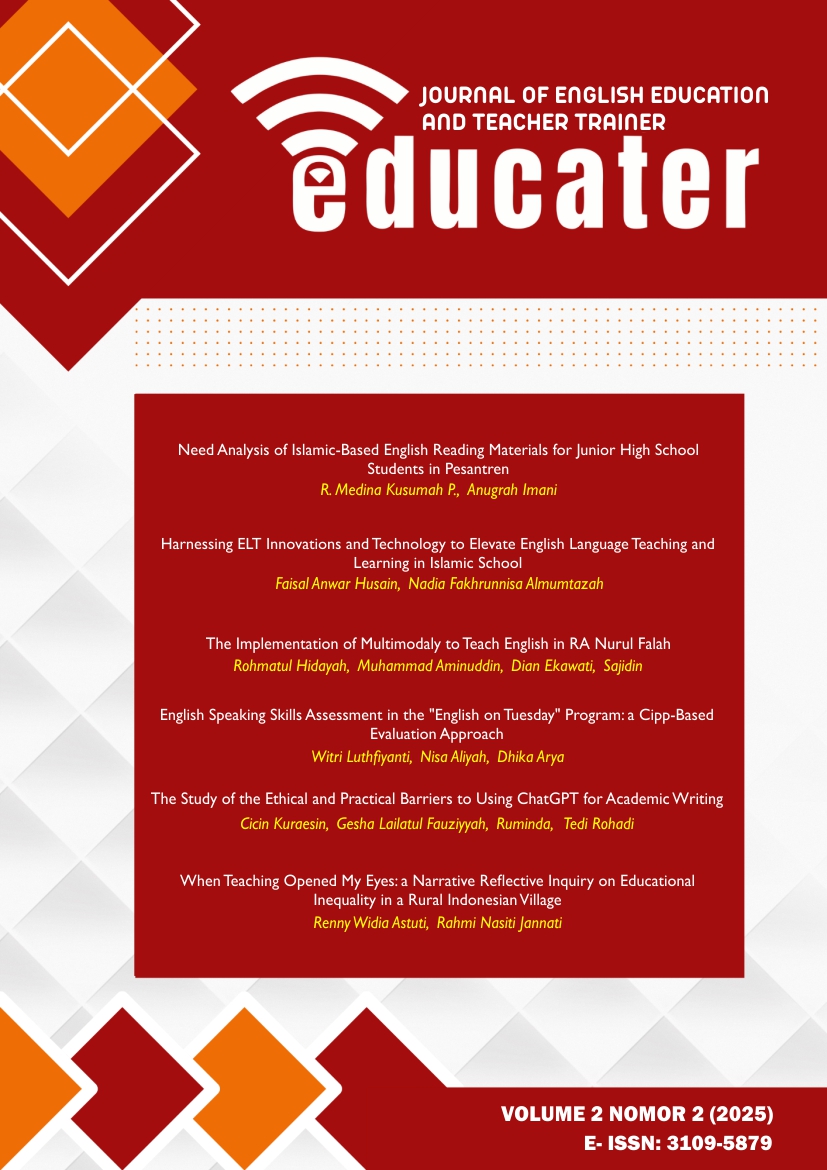
The Study of the Ethical and Practical Barriers to Using ChatGPT for Academic Writing
DOI:
https://doi.org/10.15575/educater.v2i2.2299Keywords:
Academic Writing, Ethical and Practical Barriers, ChatGPTAbstract
This study investigates the ethical and practical barriers to using ChatGPT for academic writing from students' perspective. This study used a qualitative research design to examine the ethical and practical challenges that university students face when using ChatGPT for academic writing. Fifteen participants were randomly selected from undergraduate and master's programs at ten universities in West and Central Java who used ChatGPT for their academic writing. The result showed ChatGPT’s use in academic writing presents both ethical and practical challenges. Ethical issues include the risk of plagiarism, undermining critical thinking, and maintaining research authenticity, along with concerns about unreliable information and unclear institutional policies. Practical barriers involve limitations like the need for a professional version (ChatGPT-Pro), difficulty in verifying accuracy, formatting issues, lack of depth in analysis, and repetition of content. To ensure responsible use, these barriers require clear institutional guidelines and ethical standards.
References
Ajzen, I. (1991). The theory of planned behavior. Organizational Behavior and Human Decision Processes, 50(2), 179–211.
Atad, E., & Cohen, J. (2023). Look Me in the Eyes: How Direct Address Affects Viewers’ Experience of Parasocial Interaction and Credibility? Journalism, 25(4), 941–959. https://doi.org/10.1177/14648849231169886
Bozkurt, A. (2024). GenAI Et Al.: Cocreation, Authorship, Ownership, Academic Ethics and Integrity in a Time of Generative AI. Open Praxis, 16(1), 1–10. https://doi.org/10.55982/openpraxis.16.1.654
Braun, V., & Clarke, V. (2006). Using thematic analysis in psychology. Qualitative Research in Psychology, 3(2), 77–101. https://doi.org/10.1191/1478088706qp063oa
Bretag, T. (2016). Guiding academic integrity in higher education: Values, policies, and procedures. Handbook of Academic Integrity, 463–482.
Creswell, J. W., & Poth, C. N. (2018). Qualitative inquiry and research design: Choosing among five approaches (4th ed.). SAGE Publications.
Davis, F. D. (1989). Perceived usefulness, perceived ease of use, and user acceptance of information technology. MIS Quarterly, 13(3), 319–340.
Eret, E., & Gokmenoglu, T. (2010). Plagiarism in higher education: A case study with prospective academicians. Procedia-Social and Behavioral Sciences, 2(2), 3303–3307.
Eyal, L., & Cohen, N. (2021). AI literacy: Developing critical awareness and ethics in education. International Journal of Educational Technology in Higher Education, 18(1), 1–17.
Fadillah, E. N., Saridah, S., Kamilasari, M., Nur'aida, A., Kamilia, A., & Sulaeman, D. (2025). Enhancing Prior Knowledge Development in English Language Education through Chat GPT-Assisted Learning. Journal of Languages and Language Teaching, 13(1), 390-401.
Fishbein, M., & Ajzen, I. (2010). Predicting and changing behavior: The reasoned action approach. Psychology Press.
Gray, M. L., & Suri, S. (2019). Ghost work: How to stop Silicon Valley from building a new global underclass.
Guleria, A., Krishan, K., Sharma, V., & Kanchan, T. (2023). ChatGPT: ethical concerns and challenges in academics and research. Journal of Infection in Developing Countries, 17(9), 1292–1299. https://doi.org/10.3855/jidc.18738
Gao, R., Yu, D., Gao, B., Hua, H., Hui, Z., Gao, J., & Yin, C. (2025). Legal Regulation of AI-assisted Academic Writing: Challenges, Frameworks, and Pathways. Frontiers in Artificial Intelligence, 8. https://doi.org/10.3389/frai.2025.1546064
Herda, R. K., Travero, A. S., Kafabih, A., Koeswoyo, A. W., Sari, R. N., Hakiki, F. I., & Wahidah, N. (2024). Opportunities of Using Chatgpt in Academic Writing: Perceptions of the Philippines and Indonesian Students. Jurnal Wahana Pendidikan, 11(2), 205. https://doi.org/10.25157/jwp.v11i2.14922
Hryciw, B. N., Seely, A., & Kyeremanteng, K. (2023). Guiding Principles and Proposed Classification System for the Responsible Adoption of Artificial Intelligence in Scientific Writing in Medicine. Frontiers in Artificial Intelligence, 6. https://doi.org/10.3389/frai.2023.1283353
Imran, M., & Almusharraf, N. (2023a). Analyzing the Role of ChatGPT as a Writing Assistant at Higher Education Level: A Systematic Review of the Literature. Contemporary Educational Technology, 15(4), ep464. https://doi.org/10.30935/cedtech/13605
Imran, M., & Almusharraf, N. (2023b). Analyzing the Role of ChatGPT as a Writing Assistant at Higher Education Level: A Systematic Review of the Literature. Contemporary Educational Technology, 15(4), ep464. https://doi.org/10.30935/cedtech/13605
Kallio, H., Pietilä, A. M., Johnson, M., & Kangasniemi, M. (2016). Systematic methodological review: Developing a framework for a qualitative semi‐structured interview guide. Journal of Advanced Nursing, 72(12), 2954–2965.
Khairul, W., Wan, A., Ibrahim, A., & Anas, N. (2024). Ethical risks of using ChatGPT in higher education institutions in Malaysia Risiko etis penggunaan ChatGPT di institusi pendidikan tinggi di Malaysia. 432–445.
Kiili, C., Räikkönen, E., Bråten, I., Strømsø, H. I., & Hagerman, M. S. (2023). Examining the Structure of Credibility Evaluation When Sixth Graders Read Online Texts. Journal of Computer Assisted Learning, 39(3), 954–969. https://doi.org/10.1111/jcal.12779
Klarin, J., Hoff, E., Larsson, A., & Daukantaité, D. (2024). Adolescents’ Use and Perceived Usefulness of Generative AI for Schoolwork: Exploring Their Relationships With Executive Functioning and Academic Achievement. Frontiers in Artificial Intelligence, 7. https://doi.org/10.3389/frai.2024.1415782
Kumpasoğlu, G. B., Campbell, C., Saunders, R., & Fonagy, P. (2024). Therapist and Treatment Credibility in Treatment Outcomes: A Systematic Review and Meta-Analysis of Clients’ Perceptions in Individual and Face-to-Face Psychotherapies. Psychotherapy Research, 35(1), 139–154. https://doi.org/10.1080/10503307.2023.2298000
Lincoln, Y. S., & Guba, E. G. (1985). Naturalistic inquiry. SAGE Publications.
Levine, J. H., McCabe, D. L., & Tribble, E. B. (2001). What We are Earning About: Academic Integrity. About Campus, 6(1), 9-16.
Nandang, A., Behesyti, S. H., & Nugraha, D. (2024). The Use of Augmented Reality (AR) Technology to Improve Students’ Arabic Vocabulary Comprehension and Pronunciation at Madrasah Aliyah. Tadris Al-’Arabiyyah: Jurnal Pendidikan Bahasa Arab Dan Kebahasaaraban, 3(2), 274–291. https://doi.org/10.15575/ta.v3i2.39432
Nugraha, D., Husni, F. A. N., Ruhendi, A., & Suhartini, A. (2025). Evaluation The Development Of Diversity Students Elementary School. 1(1).
Nguyen, A., Kremantzis, M. D., Essien, A., Petrounias, I., & Hosseini, S. (2024). Editorial: Enhancing Student Engagement Through Artificial Intelligence (AI): Understanding the Basics, Opportunities, and Challenges. Journal of University Teaching and Learning Practice, 21(06). https://doi.org/10.53761/caraaq92
Nugraha, D., Husni, F. A. N., Ruhendi, A., & Suhartini, A. (2025). Evaluation The Development Of Diversity Students Elementary School. Japdimas: Jurnal Pengabdian Masyarakat, 1(1), 1–8.
Ojo, O. O., & Kiobel, B. (2024). Optimizing Data Management in Healthcare: Lessons From Clinical Trials and Beyond. World Journal of Biology Pharmacy and Health Sciences, 19(3), 218–231. https://doi.org/10.30574/wjbphs.2024.19.3.0626
Ossa, L. A., Lorenzini, G., Milford, S. R., Shaw, D., Elger, B. S., & Rost, M. (2024). Integrating Ethics in AI Development: A Qualitative Study. BMC Medical Ethics, 25(1). https://doi.org/10.1186/s12910-023-01000-0
Paunović, M., Ralević, N., & Gajović, V. (2020). Application of the C-Credibility Measure. Tehnicki Vjesnik - Technical Gazette, 27(1). https://doi.org/10.17559/tv-20200113093742
Prakash, S., Balaji, J. N., Joshi, A., & Surapaneni, K. M. (2022). Ethical Conundrums in the Application of Artificial Intelligence (AI) in Healthcare—A Scoping Review of Reviews. Journal of Personalized Medicine, 12(11), 1914. https://doi.org/10.3390/jpm12111914
Rodriguez-Saavedra, M. O., Barrientos-Alfaro, A. R., Málaga-Dávila, C. P., Chávez-Quiroz, F. G., & Arguedas-Catasi, R. W. (2025). Ethics and biases in the use of ChatGPT for academic research. International Journal of Innovative Research and Scientific Studies, 8(1), 874–885. https://doi.org/10.53894/ijirss.v8i1.4432
Scardamalia, M., & Bereiter, C. (2006). Knowledge building: Theory, pedagogy, and technology. In K. Sawyer (Ed.), The Cambridge Handbook of the Learning Sciences (pp. 97–115). Cambridge University Press.
Teel, Z. A., Wang, T., & Lund, B. (2023). ChatGPT Conundrums: Probing Plagiarism and Parroting Problems in Higher Education Practices. College & Research Libraries News, 84(6). https://doi.org/10.5860/crln.84.6.205
Venkatesh, V., Morris, M. G., Davis, G. B., & Davis, F. D. (2003). User acceptance of information technology: Toward a unified view. MIS Quarterly, 27(3), 425–478
Wertgen, A. G., & Richter, T. (2020). Source Credibility Modulates the Validation of Implausible Information. Memory & Cognition, 48(8), 1359–1375. https://doi.org/10.3758/s13421-020-01067-9
Williams, R. (2024). The Ethical Implications of Using Generative Chatbots in Higher Education. Frontiers in Education, 8. https://doi.org/10.3389/feduc.2023.1331607
Zawacki-Richter, O., Marín, V. I., Bond, M., & Gouverneur, F. (2019). Systematic review of research on artificial intelligence applications in higher education–where are the educators? International Journal of Educational Technology in Higher Education, 16(1), 1–27.
Downloads
Published
How to Cite
Issue
Section
Citation Check
License
Copyright (c) 2025 Cicin Kuraesin, Gesha Lailatul Fauziyyah, Ruminda Ruminda, Tedi Rohadi

This work is licensed under a Creative Commons Attribution-ShareAlike 4.0 International License.