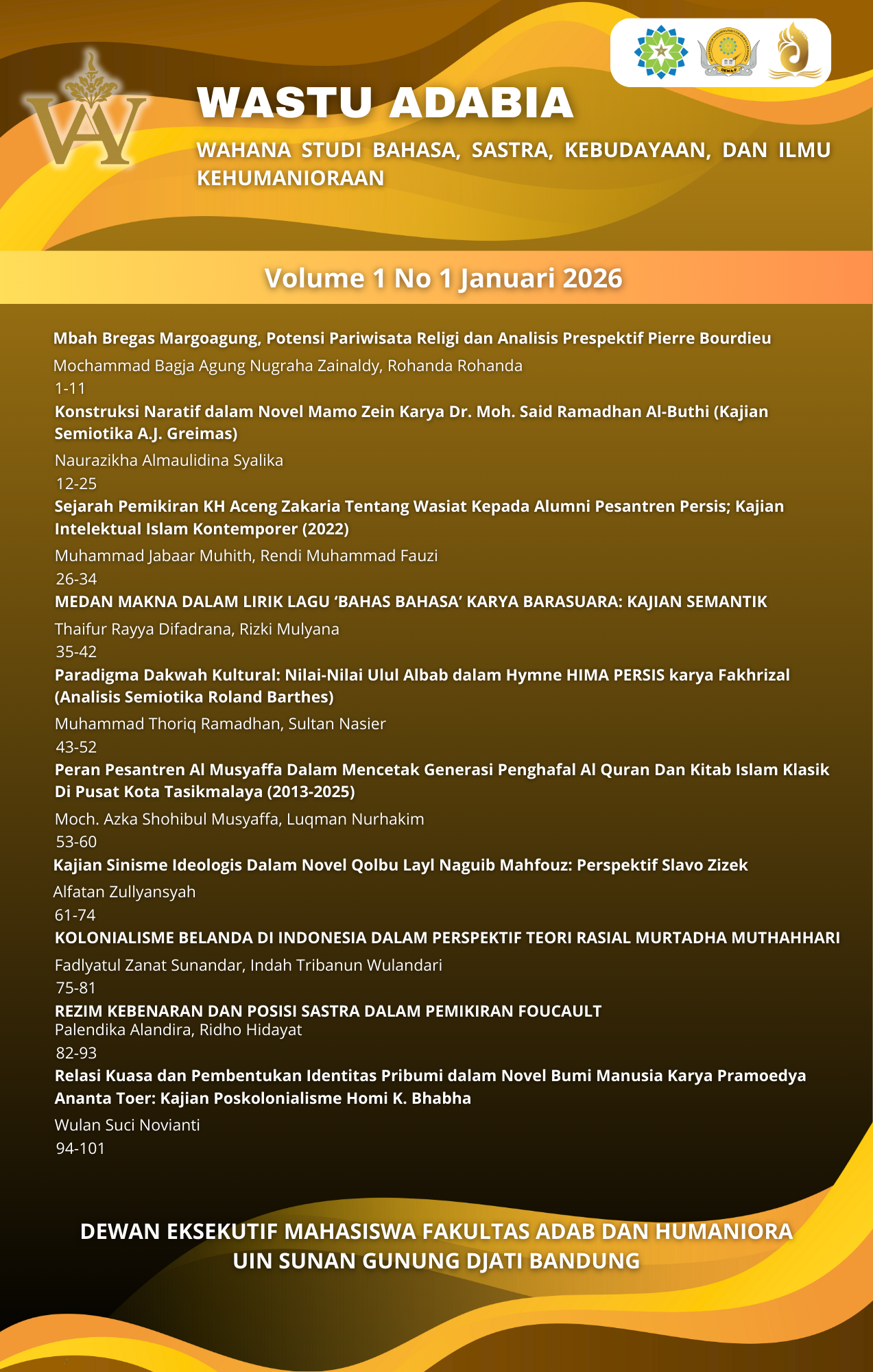
KOLONIALISME BELANDA DI INDONESIA DALAM PERSPEKTIF TEORI RASIAL MURTADHA MUTHAHHARI
Keywords:
Dutch Colonialism, Racism, Murtadha Muthahhari, Aṣabiyyah, IndonesiaAbstract
Dutch colonialism in Indonesia operated not only through political domination and economic exploitation but also through a rigid racial construction that shaped colonial social hierarchy. This article examines Dutch colonialism through the racial theory of Murtadha Muthahhari, particularly his concept of aṣabiyyah (group fanaticism) and his critique of racism as a form of structural oppression. Under the Dutch colonial system, society was divided into Europeans, Foreign Orientals, and indigenous people (inlanders), with the latter positioned at the lowest level of the social order and denied equal access to education, economic resources, and political power. This racial hierarchy reflects what Muthahhari describes as aṣabiyyah jahiliyyah, a form of racial fanaticism that contradicts the Islamic principle of human equality as articulated in Quran Surah al-Hujurat verse 13. By analyzing colonial policies such as the Cultivation System, the Ethical Policy, and social and educational segregation, this study demonstrates that racism functioned as a tool to legitimize colonial domination. Furthermore, colonialism is interpreted as a form of structural injustice and a moral pathology rooted in racial arrogance and the distortion of power. The impact of colonial racism extended beyond social stratification and educational exclusion, fostering a collective awareness among indigenous communities that racial oppression must be resisted. This awareness ultimately contributed to the emergence of nationalist movements and the active role of anti-colonial Muslim leaders in Indonesia.
References
Alisjahbana. (1966). Sociology of the Indonesian Society. P.T. Pembangunan.
Asrul, A. A., Sianturi, D. F., Tarigan, A. E., Sihotang, M., & Sinaga, R. (2024). Konstruksi Rasial Masyarakat Indonesia pada Masa Kolonial . JAHE: Jurnal Akuntansi Hukum dan Edukasi.
Chumaedi, A. (2018). Pemikiran Murtadha Muthahhari Tentang Negara dan Masyarakat serta Pandangannya terhadap Revolusi Islam Iran. Journal of Government and Civil Society.
Fahriza, N. (2022). Diferensiasi Laki-Laki dan Perempuan dan Keadilan Gender Menurut Murthadha Muthahhari. Riau: Universitas Islam Negeri Sultan Syarif Kasim Riau Repository.
Gouda, F. (1995). Dutch Culture Overseas: Colonial Practice in the Netherlands Indies, 1900-1942. Amsterdam: Amsterdam University Press.
Ismail, F. (2008). "Islamic Modernism and the Ethics of Colonialism". Studia Islamika.
Jarmoko, B. S. (2025, Februari 6). Pengadilan Era Kolonial Belanda dari Landraad Sampai Hooggerechtshof. Retrieved Desember 15, 2025, from https://www.dandapala.com/article/detail/pengadilan-era-kolonial-belanda-dari-landraad-sampai-hooggerechtshof
Muthahhari, M. ( 1993). Sayri dar Nahj al-Balaghah (A Journey Through Nahj al-Balaghah). Tehran: Intisharāt-e Ṣadrā.
Muthahhari, M. (1979). Al-Ādāb al-Muʿāsharah maʿa al-Qurʾān. Beirut: Dār al-Zahrā.
Muthahhari, M. (1983.). Man and Faith. Tehran: Islamic Propagation Organization. Tehran: Islamic Propagation Organization.
Muthahhari, M. (2001). Divine Justice . Qom: Sadra Publication.
Muthahhari, M. (2002). Understanding Islamic Sciences . London: ICAS Press.
Obet, R. (2024, Januari 25). Mengungkap Akar Isu Rasisme di Indonesia Sejak Zaman Kolonial. Dipetik Desember 15, 2025, dari https://fib.unair.ac.id/fib/2024/01/25/mengungkap-akar-isu-rasisme-di-indonesia-sejak-zaman-kolonial/
Sereliciouz. (2020, Juli 6). Politik Etis — Sejarah Kelas 11. Dipetik Desember 15, 2025, dari https://www.quipper.com/id/blog/mapel/sejarah/politik-etis-sejarah-kelas-11/
Stoler, A. (1985). Capitalism and Confrontation in Sumatra's Plantation Belt. Yale University Press.
Sugianto, R. A. (2024). Konsep Keadilan dalam Pandangan Murtadha Mutahahhari. Jakarta: Universitas Islam Negeri Syarif Hidayatullah Jakarta Repository.
Sutherland, H. (1977). "The Making of a Bureaucratic Elite". Journal of Southeast Asian Studies.
Downloads
Published
How to Cite
Issue
Section
License
Copyright (c) 2026 Wastu Adabia

This work is licensed under a Creative Commons Attribution-NonCommercial-ShareAlike 4.0 International License.
Wastu Adabia adalah jurnal akses terbuka, yang berarti semua konten tersedia secara bebas tanpa biaya bagi pengguna maupun institusinya. Artikel yang diterbitkan dalam jurnal ini dilisensikan di bawah Creative Commons Attribution-ShareAlike 4.0 International (CC BY-SA 4.0).
Dengan lisensi ini, penulis dan pembaca dapat:
-
Berbagi — menyalin dan mendistribusikan ulang materi dalam media atau format apa pun
-
Adaptasi — mencampur, mengubah, dan membangun dari materi untuk tujuan apa pun, bahkan secara komersial
Dengan syarat sebagai berikut:
-
Atribusi — Anda harus memberikan kredit yang sesuai, menyertakan tautan ke lisensi, dan menunjukkan jika ada perubahan yang dilakukan.
-
BerbagiSerupa — Jika Anda mengubah, mengadaptasi, atau membangun dari materi, Anda harus mendistribusikan kontribusi Anda dengan lisensi yang sama seperti karya asli.
Informasi selengkapnya mengenai lisensi ini tersedia di:
https://creativecommons.org/licenses/by-sa/4.0/deed.id