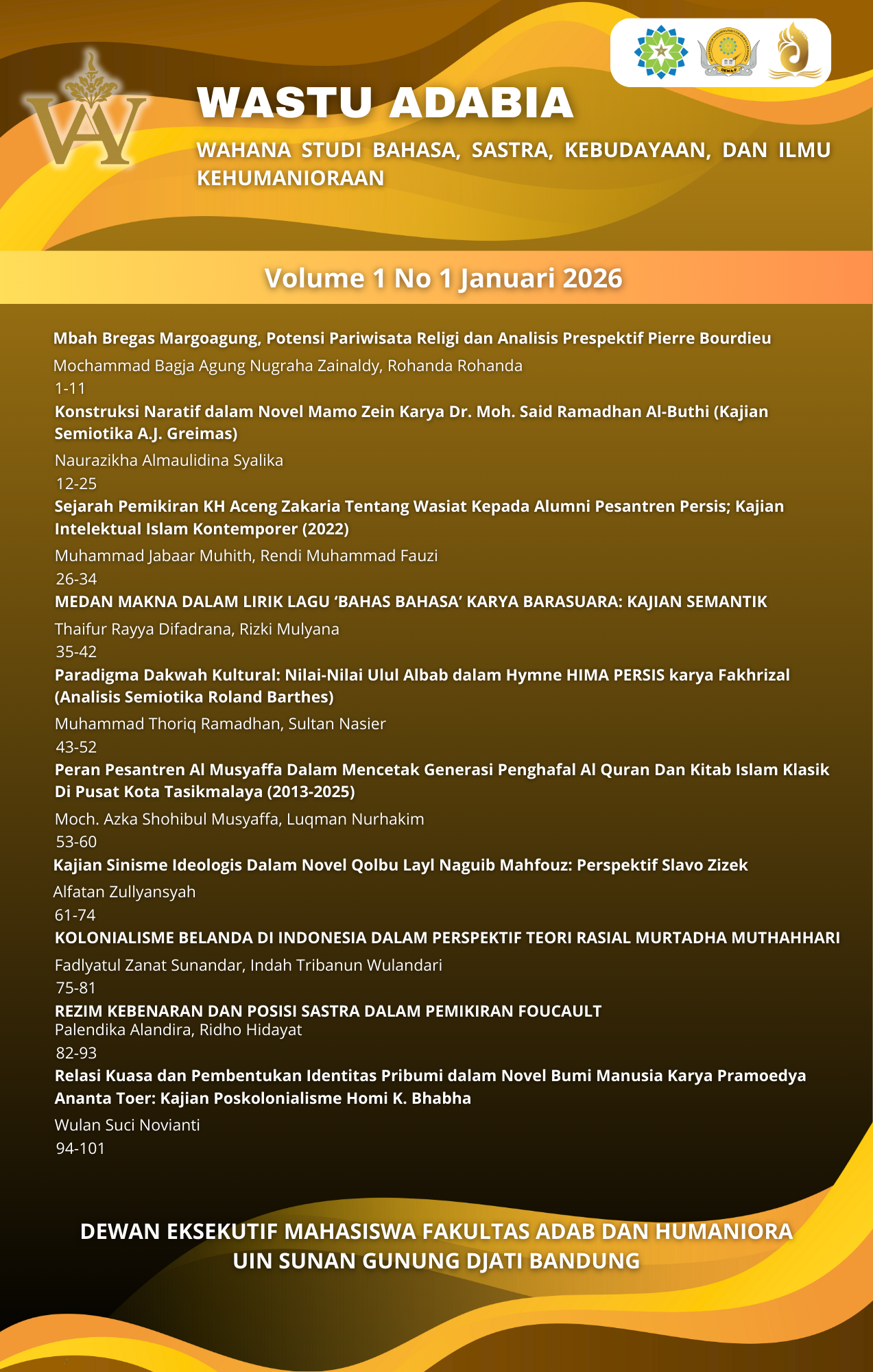
REZIM KEBENARAN DAN POSISI SASTRA DALAM PEMIKIRAN FOUCAULT
Keywords:
: Michel Foucault; Regime of Truth; Literature; Discourse; Power; SubjectivityAbstract
This article discusses the concept of the regime of truth in Michel Foucault’s thought and reflects on the position of literature within networks of power–knowledge. Departing from Foucault’s critique of the modern understanding of truth as neutral and universal, this study views truth as the product of discursive practices that are always bound to relations of power and specific historical conditions. Within this framework, literature is not positioned merely as an aesthetic object, but as a discursive practice that operates both within and at the margins of regimes of truth. This research employs a qualitative philosophical approach using library research methods and conceptual hermeneutic analysis of Michel Foucault’s major works as well as relevant secondary literature. The findings indicate that literature occupies an ambivalent position: it is subject to mechanisms of meaning production regulated by power, yet it also possesses critical potential to disrupt and problematize established truth claims. Through linguistic disobedience, semantic ambiguity, and the formation of alternative subjectivities, literature can be understood as a space for epistemological critique and a praxis of freedom.Thus, this article asserts that, from a Foucauldian perspective, literature is not a source of counter-truth, but rather a reflective field that questions how truth is produced, legitimized, and operated within modern society.
References
Arianty, M. W., Rohanda, R., & Budiharjo, I. G. (2020). Ideologi Patriarki dalam Novel Wa Nasitu Anni Imra’ah Karya Ihsan Abdul Quddus. Hijai-Journal on Arabic Language and Literature, 3(1), 10–27.
Eagleton, T. (1983). Literary Theory: An Introduction. Basil Blackwell Ltd.
Foucault, M. (1972). The Archaeology of Knowledge. Pantheon Books.
Foucault, M. (1976). Discipline and Punish: The Birth of the Prison. Vintage Books.
Foucault, M. (1980). Power/Knowledge: Selected Interviews and Other Writings 1972–1977. Pantheon Books.
Haugaard, M. (2022). Foucault and Power: A Critique and Retheorization. Critical Review, 34(3–4), 341–371. https://doi.org/10.1080/08913811.2022.2133803
Ratna, N. K. (2013). Teori, Metode, dan Teknik Penelitian Sastra: Dari Strukturalisme hingga Postrukturalisme Wacana Feminisme. Pustaka Pelajar.
Rohanda, R. (2005). Model Penelitian Sastra Interdisipliner. Adabi Press.
Rohanda, R. (2016). Metode Penelitian Sastra: Teori, Metode, Pendekatan, dan Praktik. LP2M UIN Sunan Guung Djati.
Salsabila, S., Rohanda, R., & Kodir, A. (2025). Ilmu Mantik Perspektif Filsafat Ilmu Kajian Ontologi, Epistemologi, dan Aksiologi. Ihtimam: Jurnal Pendidikan Bahasa Arab, 8(01), 219–237.
Suci Novianti, W., Rohanda, R., Fauziah, I., & Alandira, P. (2025). Hierarchy of Needs of the Main Character in Habiburrahman El Shirazy’s Ayat-Ayat Cinta: A Study of Abraham Maslow’s Psychology. ELS Journal on Interdisciplinary Studies in Humanities, 8(2 SE-Articles), 353–369. https://doi.org/10.34050/els-jish.v8i2.44340
Syafiuddin, A. (2018). Pengaruh kekuasaan atas pengetahuan (memahami teori relasi kuasa Michel Foucault). Refleksi Jurnal Filsafat Dan Pemikiran Islam, 18(2), 141–155.
Zaidan, Y. F. (2020). Kritik Sandra Lee Bartky Terhadap Pemikiran Michel Foucault. JAQFI: Jurnal Aqidah Dan Filsafat Islam, 5(2), 134–153.
Downloads
Published
How to Cite
Issue
Section
License
Copyright (c) 2026 Wastu Adabia

This work is licensed under a Creative Commons Attribution-NonCommercial-ShareAlike 4.0 International License.
Wastu Adabia adalah jurnal akses terbuka, yang berarti semua konten tersedia secara bebas tanpa biaya bagi pengguna maupun institusinya. Artikel yang diterbitkan dalam jurnal ini dilisensikan di bawah Creative Commons Attribution-ShareAlike 4.0 International (CC BY-SA 4.0).
Dengan lisensi ini, penulis dan pembaca dapat:
-
Berbagi — menyalin dan mendistribusikan ulang materi dalam media atau format apa pun
-
Adaptasi — mencampur, mengubah, dan membangun dari materi untuk tujuan apa pun, bahkan secara komersial
Dengan syarat sebagai berikut:
-
Atribusi — Anda harus memberikan kredit yang sesuai, menyertakan tautan ke lisensi, dan menunjukkan jika ada perubahan yang dilakukan.
-
BerbagiSerupa — Jika Anda mengubah, mengadaptasi, atau membangun dari materi, Anda harus mendistribusikan kontribusi Anda dengan lisensi yang sama seperti karya asli.
Informasi selengkapnya mengenai lisensi ini tersedia di:
https://creativecommons.org/licenses/by-sa/4.0/deed.id